
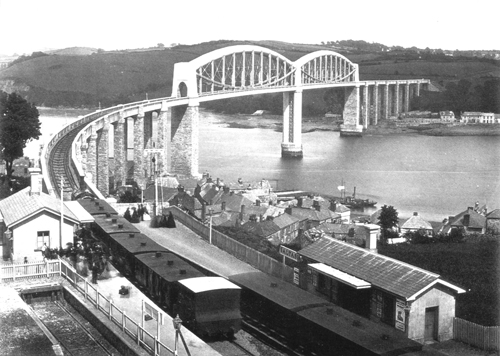
In October 2009 I posted a blog on my sampling of the paint on the Royal Albert Bridge. [That post can be seen here – A Brunel Bridge – part one] I had been employed by Network Rail to identify how the Isambard Kingdom Brunel-designed bridge had been painted when it was opened in 1859.
At the time I was still carrying out the examination of the cross sections and undertaking their analysis. By early December it had become clear how the bridge had been first treated and I was able to produce my report.
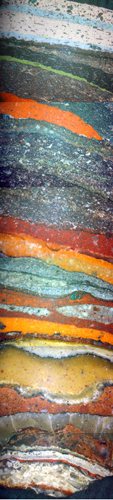
The first scheme applied to the Bridge is a complex one and was carried out in two phases. The early photographic evidence and previous work carried out on road bridges over the River Thames gives support to this statement. It is believed to have been applied in five coats. In normal circumstances the application of four coats of paint would have been regarded as a standard treatment for external ironwork at this period; however bridges were usually given greater protection.
The ironwork was initially given two coats of lead white ground in oil. The overall colour of both of these would have been off-white.
Experience suggests that these first two coats are likely to have been applied to the ironwork before it was erected. For example, of three London road bridges recently investigated – Tower Bridge, and Battersea and Hammersmith Bridges – each had been painted before erection.
The third coat was in a paint made up of red iron oxide in oil. This pigment was used extensively on ironwork in the late nineteenth century. In view of the fact that a light tint is visible in the early photographs it is believed that the red iron oxide was applied once the Bridge had been assembled.
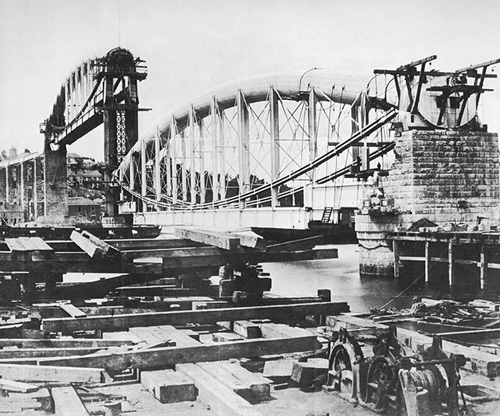
Acknowledgement: Science Museum
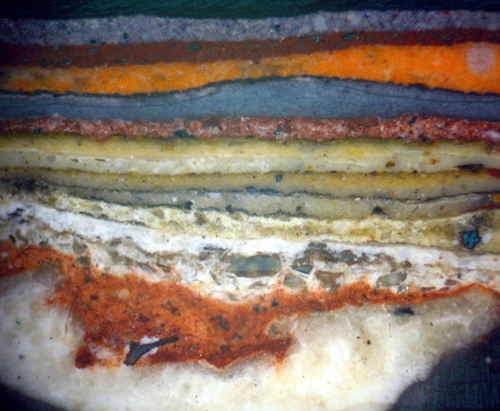
The fourth coat in this first scheme is very interesting and is a very good example of what was called an “Anti-Corrosive” paint. Already by this time there was a long tradition for using textured paints in order to prolong the life of an external decorative scheme. Sand, road dust or ground glass was frequently added to oil-based paint to achieve this. On this occasion particles of glass can be seen quite clearly in this off-white layer of paint. A very similar paint has also been found by me on the iron framework of the Great Conservatory at Syon House. The first scheme was completed when the ironwork was given a fifth coat of paint, which was also off-white.
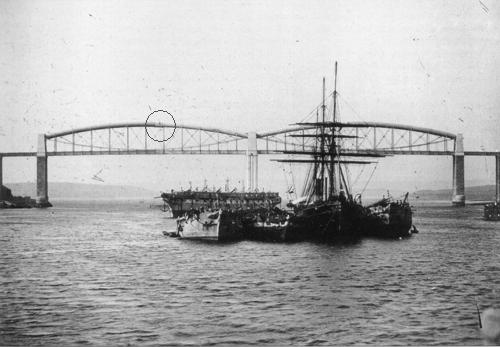
Presumably the “Anti-Corrosive” paint was not as effective as was believed, for in 1861 the bridge was re-painted at a cost of £1,767 3s 3d.
Incredibly, a photograph taken in 1861 shows a solitary figure painting the Cornwall Span:
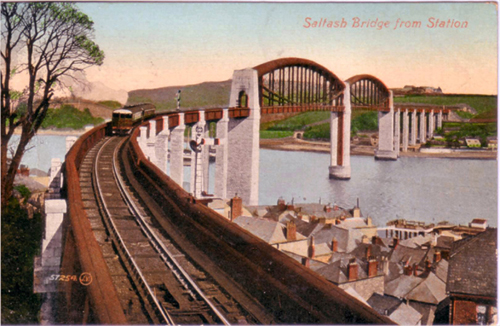
Between 1867 and 1882 a dark red-brown colour was employed on the ironwork. Such a scheme can be seen in this undated hand-coloured postcard.
Subsequent schemes are unclear as a result of paint stripping operations carried out in recent years. However, it can be seen that grey had been employed for the last sixty of its 150 years. In view of the various modifications that have been carried out, the Bridge no longer looks like the one that was erected in 1859. For that reason there seemed no compelling need to replicate the original pale stone colour and an all-over grey was recommended as being as valid as any other.
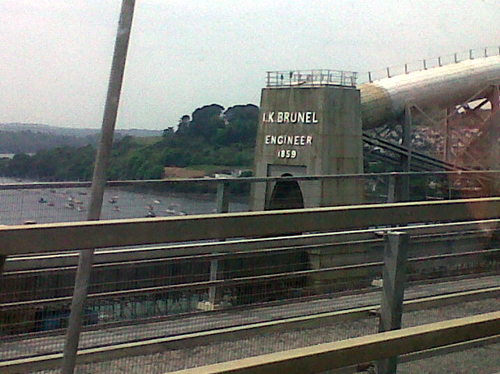
Since the above was written my dear Twitter friend Nerys Watts (@NerysW) has sent me a photograph showing the Devon span being painted:
More recently I have been sent this photo by Tom Bowden showing the slow progress of repainting.
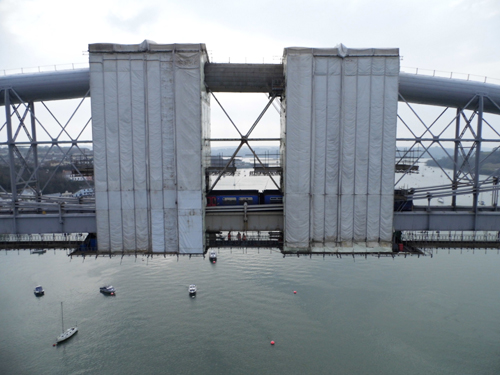
Note also the size of the bridge relative to the train and the workmen below – March 2013. Credit T.N. Bowden
A podcast on Isambard Kingdom Brunel from the Oxford Dictionary of National Biography can be found here:


 on
on  on
on  on
on 
Dear Patrick, I just had a chat with Nick Tyson about the Regency Town House and he mentioned your blog and website. Very impressive. I must dash to the Royal Pavilion now but will have a closer look at everything a bit later. Here is my own take on colour in art and architecture (much less professional than yours): http://colourlightandshade.blogspot.com/
Best, Alexandra
Very interesting and well presented in an easy to understand style. Thank you.
You mention that you were unable to ascertain the grey paint type of the last 60 years. It would most probably have been BR standard grey micacious iron oxide as per the BR handbook until the early 1990′s at least. It looked it to me when I did my tube walk ton about 1987. The colour of this paint was a darkish grey with obvious mica fragments but changed to a light grey later on (the latter may have been an epoxy resin type paint as these were recommended for use over water at the time.
Very helpful. Thank you. The emphasis here was finding the original colour. As so often happens the client was unable to supply me with any information about more recent schemes. I gave a detailed account of the first seven, which took it to the late 1880s. Micaceous iron oxide was already being used at that stage.
Hi Patrick,
I found your information on the Royal Albert bridge very interesting. Thank you.
I am in the proceed of making the very bridge on a oo railway layout.
I was not too sure what colour to paint it, it certainly has changed since new . I do believe now it’s called Goose grey.
I’m not really sure what colour it was in it’s first few years.
At the moment I have given it a first coat of grey and it looks pretty good. Do you think it would matter too much if it wasn’t the exact colour ?
Kind regards
Brian.
Thanks Brian.
It was off-white originally and a pale greyish colour on the third and fourth occasions. I am not sure what they decided to do with it following my research. Grey would make sense. It was certainly that colour when I sampled it.